

Glossary
FDM: Fused Deposition Modeling, an additive manufacturing method that builds an object by melting material layer by layer.
Thermoplastic materials: Materials that become softer when heated and harder when cooled.
Post processing: Any task or process after the 3D printing is completed, such as surface finishing, cleaning or painting
Mechanical strength: Ability to resist the force applied on the object
FDM Overview
FDM Basics
In Fused Deposition Modeling (FDM), also known as Fused Filament Fabrication (FFF), thermoplastic materials are melted through an extruder to form an object layer by layer. FDM printers are user-friendly, easy and safe to use devices that allows rapid prototyping. Advantages such as little to no post-processing requirements, versatility and personalization make FDM printers ideal for a variety of applications.
Depending on the needs and requirements, the material must be selected carefully. Temperature, visual quality, mechanical characteristics or simply easy of printing are some of the factors that need to be taken into consideration. This guide lists the most popular materials that are used in FDM printing.
Material Types
ABS
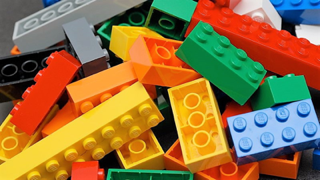
Acrylonitrile butadiene styrene (ABS) is one of the mostly used material types in 3D printing, due to its high mechanical strength, resistance to high temperature (from -20ºC to 80ºC) and low cost. With ABS, little post-processing is required and shiny, smooth surfaces can be printed. Print bed must be heated (to 80ºC) as it shrinks if cooled fast. Also it needs to be printed in an enclosed space to be protected from particle emissions, and stored in sealed conditions as it absorbs moisture from the environment.
Print temperature: 230-260ºC
Pros:
- High mechanical strength
- High temperature resistance
- Lightweight
- Little post-processing
Cons:
- Requires heated print bed
- Not biodegradable
- Harder to print (compared to PLA)
- Bad odour & potentially harmful fumes
- Absorbs moisture from the environment
- UV sensitive
PLA
Polylactic acid or polylactide (PLA) is an environmentally friendly and biodegradable polymer made from corn starch or sugar cane. It is the easiest material to work with and the perhaps the most commonly used filament type. It is not viable for extremely high mechanical loads but offers reasonable strength for most of the applications. Heated print bed is not necessary and it prints at a lower temperature than ABS.
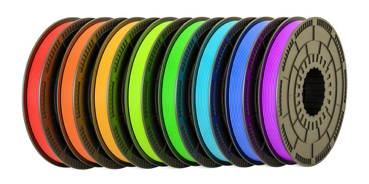
Print temperature: 190-230ºC
Pros:
- Easy to print
- Biodegradable
- Good mechanical performance
- Easy to post-process
- Available in variety of colors
- Good UV resistance
- Lower print temperature
PETG
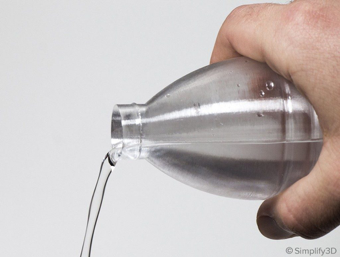
Glycolized polyester is a recyclable plastic that offers high strength and resistance. It is produced by adding glycol to PET, what water bottles are made of, to increase its brittleness. It requires a heated print bed, with a temperature of 75-90ºC. It is commonly used in water proof applications.
Print temperature: 220-260ºC
Pros:
- Good thermal performance
- Can contact with foods
- High strength
- Moisture resistant
- Low shrinkage
- Weather resistant
- Odourless when printing
Cons:
- Not suitable for supports
- Heavier than ABS and PLA
- UV sensitive
- Oozing
PVA
Polyvinyl Alcohol (PVA) is a biodegradable polymer that dissolves in water. It is ideal for support structures, since it can be removed easily with water. PVA is mostly used in dual extruder 3D printers, such as Ultimaker 3, and only used in supports.
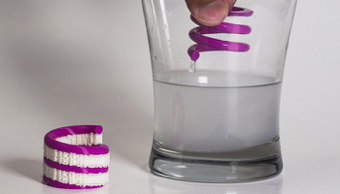
Print temperature: 185-200ºC
Pros:
- Water soluble
- Ideal for supports
Cons:
- Moisture sensitive
- Cost
- Clogging
- Requires a dual extruder printer
Breakaway Material
Ultimaker’s breakaway material, a Polyurethane/PLA blend, is used for the support structures. The main advantage this material is the good surface finish after the removal of the supports on the faces of object contacting the supports. Although PVA supports provide great surface quality, the object needs to be submerged in water to dissolve the supports. Breakaway material comes in handy when you don’t want to wait for PVA to dissolve in water. Additionally, with breakaway materials, it is easier to remove supports compared to other materials (PLA, ABS etc.). It is compatible with PLA and ABS.
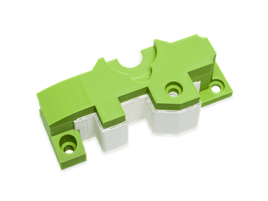
Print temperature: 215-230ºC
Pros:
- Ideal for supports
- Good surface finish
- Easy to remove
- Long shelf life (not sensitive to moisture)
Cons:
- Requires a dual extruder printer
- Not useful for internal supports
See also
You may also wish to review:
3D Printing Directory
FDM Directory
References
https://www.simplify3d.com/support/materials-guide/pva/
https://www.3dnatives.com/en/plastics-used-3d-printing110420174/#!
https://www.3dhubs.com/knowledge-base/fdm-3d-printing-materials-compared/#introduction
https://www.treatstock.co.uk/guide/article/118-express-guide-of-fdm-3d-printing-materials
https://all3dp.com/1/3d-printing-materials-guide-3d-printer-material/